Learning from economic history
The GPT concept that's far bigger than AI
The acronym 'GPT' exploded into the public consciousness with ChatGPT, itself powered by GPT-3.5. In that narrow context, GPT stands for Generative Pre-trained Transformer, where a transformer is a neural network architecture pioneered at Google.
We're interested in a much bigger concept of GPT: General Purpose Technologies. (This is what we'll use 'GPT' for in this essay.)
In short, GPTs are the big, era-defining technologies - such as steam power, electricity, personal computing.
There's not many technologies like this, but they exist - and become era-defining by being "powerful enough to accelerate the overall course of economic progress".
AI seems to uncontroversially be a GPT - both in a common sense intuitive way (it's a technology with 'general purpose' because you can throw AI at a huge range of problems) and also by the semi-formal classification criteria from the literature:
1. Pervasiveness – The GPT should spread to most sectors.
2. Improvement – The GPT should get better over time and, hence, should keep lowering the costs of its users.
3. Innovation spawning – The GPT should make it easier to invent and produce new products or processes
So, whilst AI in its modern LLM-based incarnation is a relatively recent phenomenon, it is in a lineage of great GPTs that drove enormous gains in productivity and living standards.
AI is probably the most powerful (and the most general) GPT that humanity has seen before - and it may be particularly special in being both a GPT and an 'invention of method of invention'. But there is a rich literature on the economic history of GPTs which we can refer to, to understand the Post-Intelligence Bottleneck - and how to overcome it.
The productivity J-curve
The main central theme in the economic history of GPTs is that they don't typically result in immediate economic transformation.
There can be a substantial gap of many decades before an invention is used across different economies:
- ~40 years for electricity
- ~60 years for railways
- ~120 years for steamboats
Not only is there a gap on the realization of GPT productive potential - there can even be a dip in productivity in the short-term. This is termed the 'Productivity J-Curve' - so-called because the arc of productivity (a dip down followed by dramatic increase) traces out a rough J.
Why is there a J-curve? It's because GPTs are so transformative, and their potential is so huge, that they can require large, long-term investments in infrastructure to fully exploit them - and even "a fundamental rethinking of the organization of production itself".
We're going to look at two different GPTs, electricity and IT, and show that both of these experienced a J-curve - with two common factors, new infrastructure and new ways of working, ultimately unlocking their productive potential.
Case studies: electricity & IT
The 19th-20th century: electricity
The 1900 Paris Exposition was a celebration of technological progress in the 19th century and an inspiring invitation to imagine a radically different 20th century.
Electricity may have been the most striking aspect of it. One observer - a certain Henry Adams (an intellectual and historian, descended from the 2nd US President, John Adams) - wrote:
It is a new century, and what we used to call electricity is its God.
However, this was already 20 years after Thomas Edison had demonstrated his light bulb - and yet electrification still had decades to go before realizing its productive potential. At the time, fewer than 10% of US factories were electrified, and it took a further 20 years for that to reach 50% adoption.
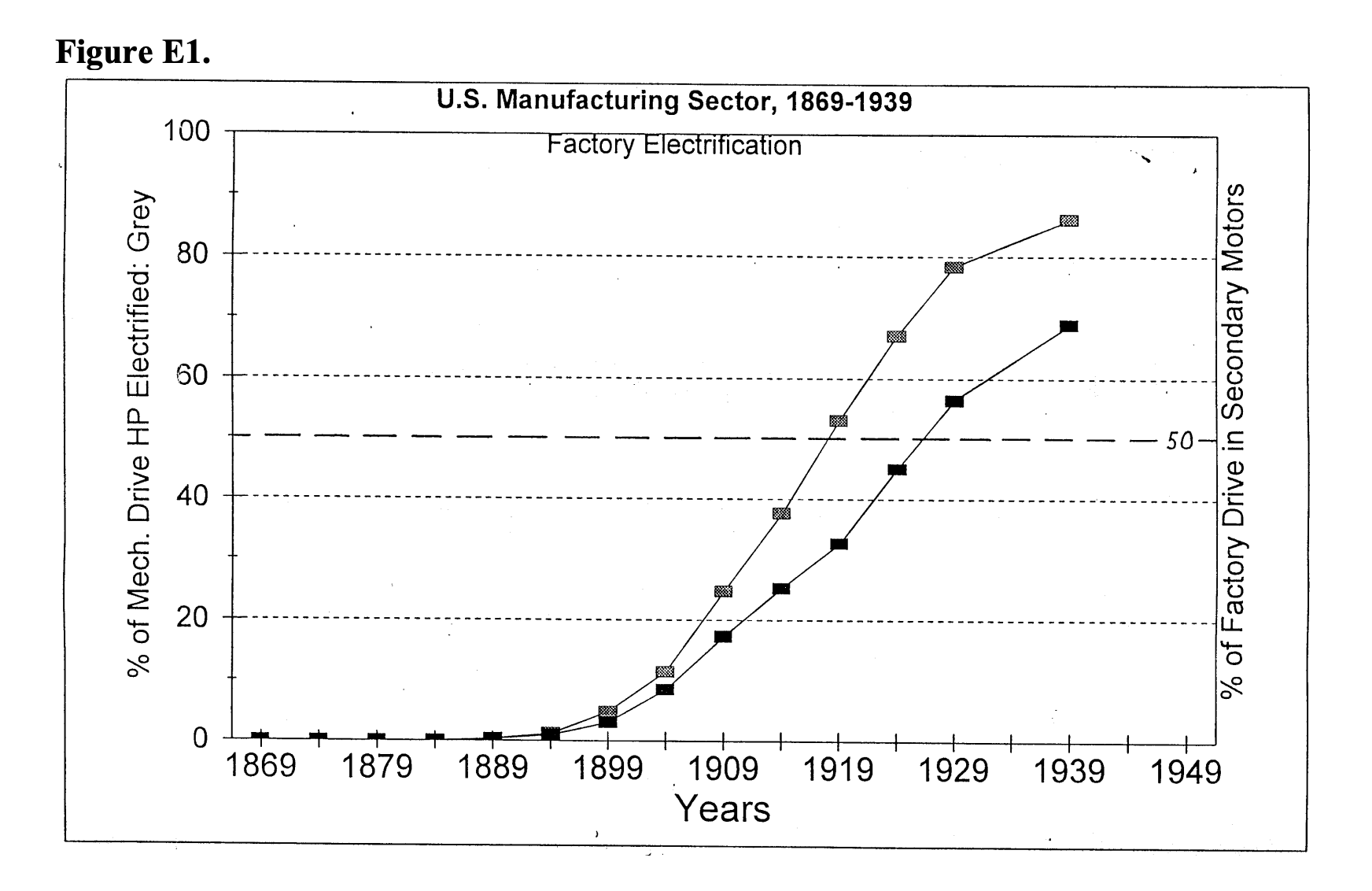 We can understand this J-curve in terms of the costs both new infrastructure and new ways of working.
- New infrastructure: factories at the time were running on water and steam - and they were both functional and profitable. Investing in electrification would have necessitated both stopping profitable production and making a huge capital outlay.
- New ways of working: the first-movers in electrification, high-growth industries (tobacco, fabricated metals, transportation) that were setting up new factories, found that it wasn't just 'swapping out steam drivers for electrical ones' - it went as wide as "new plant design and the necessary relocation of manufacturing to suitable greenfield sites outside the old urban core districts".
The late 20th century: IT
We can see the same pattern, more recently, with IT. The invention of IT - which researchers define as Intel's 1971 release of their 4004 microprocessor, the first commercially available single-chip microprocessor - was similarly associated with a decrease in trend productivity growth (shown in the dotted line in the graph below).
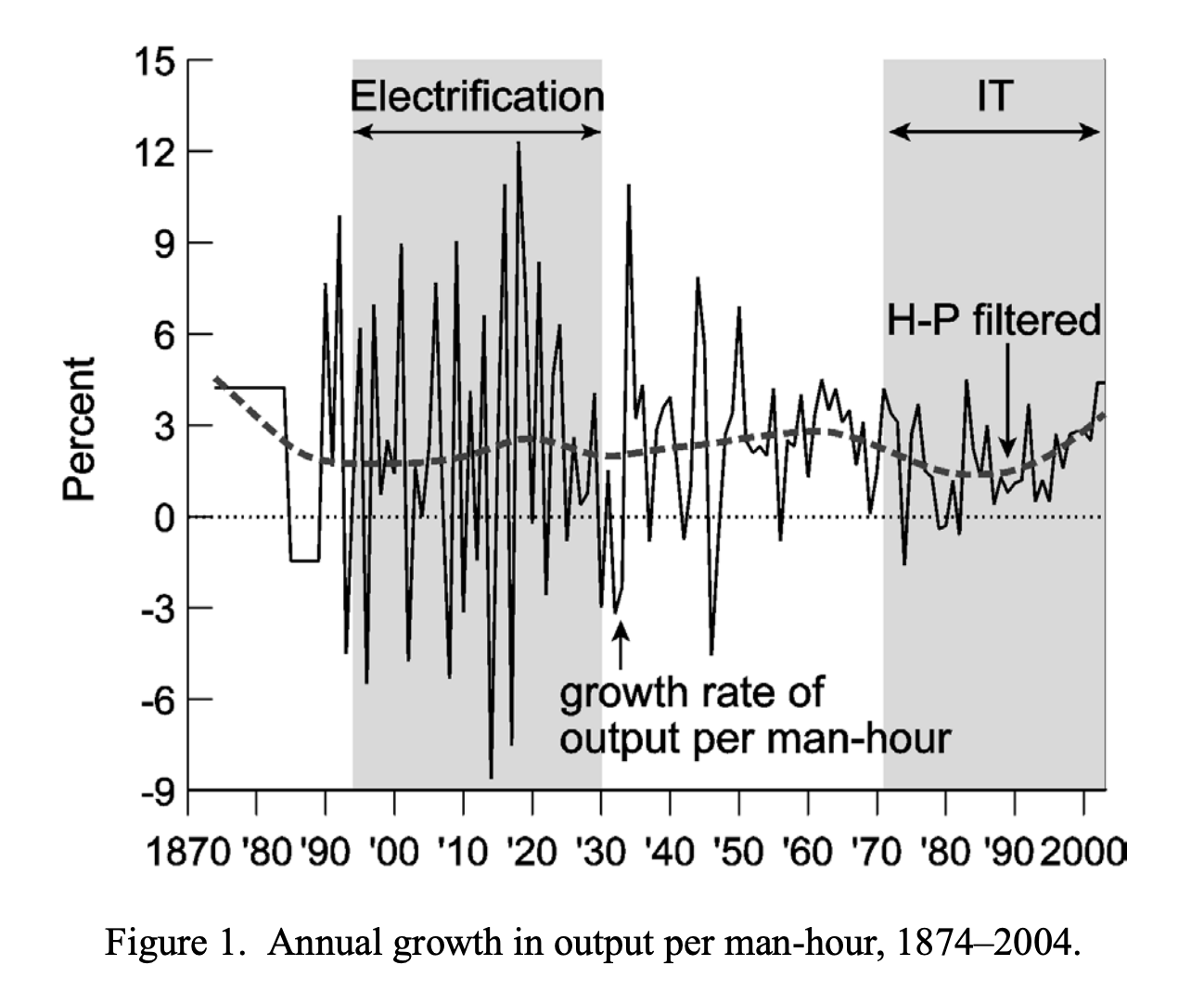 At the time, it was an open question: "Will the growth slowdown of the current IT era be followed by a rise in growth in the first half of the 21st century?". Whilst today, the six most valuable companies in the world are all technology companies (NVIDIA, Apple, Microsoft, Alphabet, Amazon, Meta) - it really wasn't apparent to the world at large that tech would be so dominant.
What explains this? It's the J-curve again. The invention of IT was itself not enough - what empirical research suggests is that it is overall organizational transformation that may have driven more of the productivity gains.
Like electricity, we can understand this as 'new infrastructure' and 'new ways of working':
- New infrastructure for organizational computing - e.g. corporate accounting systems
- New ways of working to make use of organizational computing - with impacts on profound things even like authority relationships and levels of centralization
The pattern is consistent. Electricity needed new factory designs and power grids. IT needed new organizational structures and corporate computing systems. In both cases, the technology alone wasn't enough - it took complementary infrastructure and fundamentally new ways of working to unlock the productive potential.
AI is following the same arc. We have the most powerful GPT in history, and we're trying to run it through infrastructure built for humans typing into GUIs. If history is any guide, the path to realizing AI's potential isn't more adoption - it's new infrastructure purpose-built for a world where agents, not humans, are the primary executors of knowledge work.